Against vibes
Rigor, technicality, words and sounds, artificial intelligence, ugliness, Lucas Debargue, self-expression, my old visual art

ALGERNON. Did you hear what I was playing, Lane?
LANE. I didn’t think it polite to listen, sir.
ALGERNON. I’m sorry for that, for your sake. I don’t play accurately—any one can play accurately—but I play with a wonderful expression.
(Oscar Wilde, The Importance of Being Earnest)
1.
The humanities and arts are very technical.
Technical is a loaded word. Some people, at least in the San Francisco Bay Area, use the word technical to refer to people competent at coding and use the word non-technical in a derogatory manner. This I dislike. The word technical carries connotations of rigor and logic, and as such, to be non-technical is to be the opposite, to operate based on feelings, emotions, and vibes. Even if nontechnical often refers to managers and directors, on whose behalf I cannot speak, the insult catches designers, writers, and musicians, too, who all—if they’re trying to be good—cannot eschew rigor and logic.
I wish to propose a different definition.
I think of it not as a binary but as a continuum. A task is more technical if it requires both more and proportionally more training of a specific type—intentional training that is close in nature to the task itself. Moreover, beyond the (non)technicality of a task itself, there are more technical and less technical approaches to training for that task.1
One extremely technical task is playing chess. Improvement entails working on chess puzzles (isolated positions from chess games where one has to find the correct move), memorizing chess openings (the sequences of moves to start a chess game), and playing chess tournaments. There are some exceptions: famously, the first American world chess champion Bobby Fischer, determined to build his endurance for longer matches, trained in swimming and weightlifting, a less technical (non-technical, even) approach to chess improvement. But almost everything necessary to improve at chess directly involves some element of chess itself.
Playing classical piano is still very technical, though less so. Becoming a better classical pianist entails practicing scales and arpeggios, playing lots of different pieces, and listening to and studying others’ recordings: again, training that is almost all piano or piano-adjacent. And much of what listeners take to be a product of emotion or feeling, those grand sweeping crescendi and poignant pauses—those too require specific practice, with the fingers and with the ears. But sometimes one can take a roundabout path. To play Lament better, I reflect on my former piano teacher’s passing; to play Nocturne better, I wake up at 5 A.M. to watch the sunrise. On an older learner’s recommendation I briefly try yoga to loosen my back. And as with all the arts, sometimes my improvement stems simply from interacting with more people and living more of my life. Such improvement methods—if the lattermost can be said to be methods—are less technical.
Like playing classical piano, writing personal essays, painting, composing music—all are very technical, if one cares about doing them well.
So the proposed definition above is an elaboration on other established definitions for the word:
marked by or characteristic of specialization
[…]
of or relating to technique
The degree to which specialization is required is certainly relevant to my definition! And technique—technique most certainly applies to the arts and humanities:
the manner in which technical details are treated (as by a writer) or basic physical movements are used (as by a dancer)
To be clear, whether a task is technical or not has little to do with its value. For example, each year I run admissions for SPARC. The task of selecting our final cohort is not particularly technical. Most of my improvement comes from observing how students interact with each other and with us at camp; learning how to better work with others, both friends and older adults; staying aware of trends among high-performing teenagers; and plenty of other unintentional, subconscious practice.2
2.
Ms. Dawson gave us two types of assignments in 11th-grade Expository Writing. Every week or two, we were to write short essays according to specific prompts, and in parallel, we were to practice constructing sentences that satisfied or contained certain patterns—the nominative absolute, a series of balanced pairs, participial phrases. In retrospect, I’m impressed by how well her methods worked. I still make use of those patterns today.
I strongly believe one can learn writing, as a field of study and form of craft, with the same intensity, technicality, and rigor with which they might learn mathematics, physics, or engineering. “Writing” is a word both vague and all-encompassing, and in using it I refer not to writing-as-communication—technical writing, legalese, many forms of blogging—but rather to writing with artistic intent, writing that aspires beyond the transmission of information from one mind to another. I believe the same about every form of fine art.
Is this belief self-evidently true? To me it seems so. Perhaps to those who authored the books I studied (Strunk, White, Clark, King) and those who tutored me in classical piano (Orlov, Parisot, Taylor, Nguyen) it seems so, too. But there are many who regard writing, music, and art as more so magic than the product of effort and will; who feel aesthetic taste is innate and untrainable; and who, worst of all, do not believe themselves capable of engaging with and appreciating the humanities, or learning how to do so. This is a shame.
I thought of Ms. Dawson’s sentence patterns as a chance to develop my technical skills, but they also taught me to seek beauty in small units of prose. The following sentence, regarding feedback I received about the flaws in my piano technique, comes from my piece Why music?:
I talk about his feedback to my friends at school, to my friends from math competitions, to Pei-Hsin, to—after an extended period of deliberation where I agonize over the humiliation of being vulnerable with, being myself in front of, and being seen by him—my father, a musician himself, a good one, a late bloomer, too, who picked up classical guitar in college and won a schoolwide competition.
Pattern 1, a series with a serial comma: being vulnerable with, being myself in front of, and being seen by. Pattern 2, a series without conjunctions, asyndeton: to my friends at school, to my friends from math competitions, to Pei-Hsin, to my father. Pattern 5, nonrestrictive appositives: my father, a musician himself, a good one, a late bloomer. Of course, there is more to this sentence than patterns. There is the marriage of form and content, in the concordance between the em-dash interruption’s hesitancy to resolve and my hesitancy to talk to my father, whom I choose to introduce with a pronoun preceding the em-dash to create a pause—during which the referent remains unknown—for a sense of heightened drama.
I don’t mean to suggest that I am a great writer. In fact, it is precisely because I am a hobbyist—the bulk of my formal training is in math, biostatistics, and classical piano—that I am explaining all this technical decision-making. I try my best to appreciate prose; I try my best to create it. In this way I see and contribute to more of the world.
The humanities are for hobbyists, too, because the humanities are for everyone.
3.
I am certainly not a great visual artist. But I was a hobbyist—I used to sketch my favorite Magic: the Gathering cards back in middle school, and took two art classes in high school.
Because the humanities are for everyone, and because we ought to treat them with rigor, I wish to analyze one of my old pieces from my senior year. I asked some more experienced friends to help me talk about it.
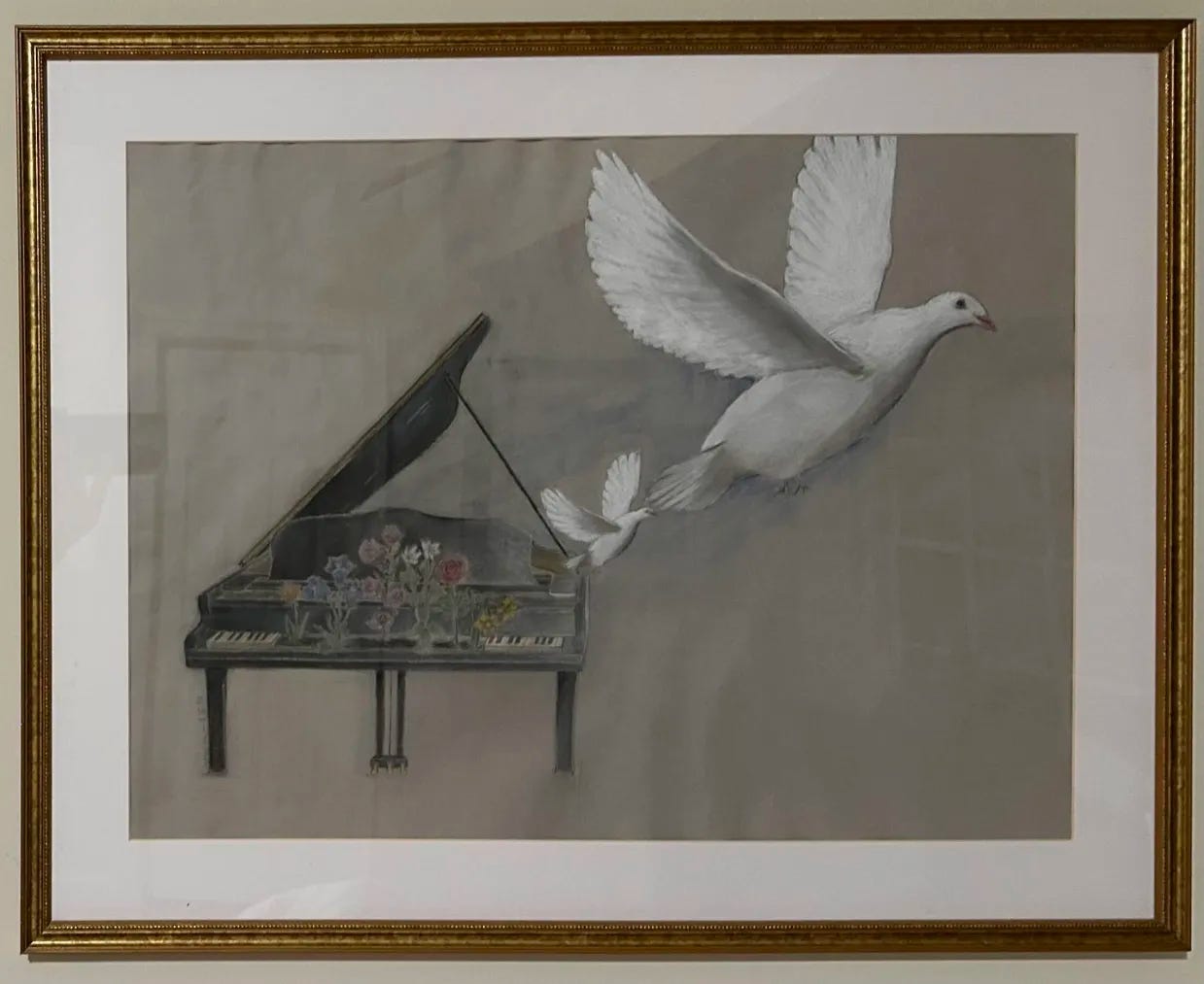
I think—it’s been almost a decade—that I wanted to convey the idea of beauty emerging from the piano: flowers blooming, doves erupting, life from the lifeless. But my intent could be clearer.
The smaller dove appears to pop from the page (such is how it is shaded), but it also looks in line with the larger one, which could confuse a viewer. And drawing more than two doves, wings in different positions and necks at different angles, could’ve more effectively conveyed motion—perhaps at first slightly transparent and then increasing in size and opacity. My doves are stock-photo doves; studying anatomy would’ve helped me execute this idea.
Exaggerating certain of the doves’ features could make the piece more dynamic: I recently visited some museums and noted how classical artists drew muscles, finely detailed and hard-edged. I could draw the doves less flat, with puffier, fluffier feathers. They could also have been shaded differently, with more colors, browns and yellows to reflect environmental information.
Much like the piano, the flowers are straight, vertical, almost regimented. They could curve more farther from the keys—I could’ve added a bush, even—to reflect the transition from something more manmade and artificial to something more natural. A gradient between the dull colors of the roots and the brighter colors of the petals could further accentuate that transition.
Finally, the background is empty. I think that was due to limited time. But I could imagine placing the piano in a grand hall, with the birds streaming out a window, the last one cut off.
4.
Holden, whom I’ve written about previously, once explained to me one component of how he learned to compose classical music: “I [listened] to everything and [asked myself] why the composers made the choices they did.”
Let me concretize everything. Music has structure. For example, a piano sonata has an exposition, a development, and a recapitulation. Those sections have themes, which themselves are constructed from melodies and harmonies. Those elements are comprised of notes. Atop the notes lie other instructions, like forte, diminuendo, or smorzando.3 Some are wordless, even: dots to indicate a detached touch, curves to indicate smoothness, (possibly inverted) L-shapes to indicate which hand ought to play which note. So a classical composer makes thousands of choices (some subconscious) in the writing of a piece. Chopin’s thirteenth Nocturne once devastated me, and understanding the mechanisms underlying its genius—the space, the sonic gap, between the bass and the melody; the interweaving of the octave triplets and the chorale; the seamless transformation of those triplets into the accompaniment for the doppio movimento—helped me understand why I loved it and how it made me feel what I felt.
Zoe, an artist, takes me to the Isabella Stewart Gardner Museum. I find the exhibitions intriguing, pretty, grand, all manner of vaguely positive adjectives, but I know next to nothing about visual art, and it is because Zoe can rattle off facts about this style and that texture that they’re enjoying everything ten times as much as I am. Later that day, Zoe and I listen to Chopin’s thirteenth Nocturne. When we talk about the music afterward, I sense their experience of Chopin matches mine of the museum.
So to relate to the arts and humanities purely through emotion is incomplete—not wrong, merely incomplete, because though they evoke emotion, they are not themselves built from emotion. After all, pieces are built from notes; prose is built from words; paintings are built from brushstrokes. This March, Sam Altman tweeted about a model and claimed it was “good at creative writing.” He presented an AI-written metafictional short story and said “it got the vibe of metafiction so right.”
I am not good at metafictional short stories. I write personal essays. I stick to facts. The model may very well be a better creative writer than I. Regardless, I find his assertion fascinating, because it suggests that to be good at metafiction is to capture the vibe of metafiction.
I disagree.
If we wish to call art good, we ought to judge it on its merits. Among those are how it makes readers feel—and yes, “vibe”—but primarily, works of creative writing comprise words, certain words arranged in certain orders. For any given work of creative writing, the null hypothesis (the baseline assumption) is this work is mediocre, or average-quality, and any claims otherwise ought to be supported with textual evidence, evidence involving those words.
For example, nostalgebraist, a writer and self-described “guy from the internet,” analyzes AI writing in their Tumblr post hydrogen jukeboxes: on the crammed poetics of “creative writing” LLMs:
This, I claim, is the main stylistic hallmark of both R1 and the new OpenAI model: the conjunction of two things that seem like “opposites” in some sense.
And in particular: conjunctions that combine
one thing that is abstract and/or incorporeal
another thing that is concrete and/or sensory
Ginsberg’s prototype example of an “eyeball kick” was the phrase “hydrogen jukebox,” which isn’t quite an LLM-style abstract/concrete conjunction, but is definitely in the same general territory.
nostalgebraist then identifies and lists twenty separate instances of eyeball kicks in the short story Altman posted. They think the eyeball kicks excessive. But that nostalgebraist thinks the eyeball kicks excessive is not the point. Rather, whether or not the writing is good, nostalgebraist has made a serious attempt to understand its features and how it is constructed. I’m not sure the same is true for Altman and the short story’s other defenders in the tweet replies.
I don’t mean to reject the value of feeling in how we relate to art. Our feelings offer us valuable information and provide a jumping-off point for further exploration: why does this writing make me feel the way it does? But feeling is not everything. To stop at feeling is to engage with art by halves.
Reading is for everyone, but we ought not to read in such a shallow way.
5.
I must now elaborate upon the importance of feeling.
I love how classical music makes me feel, both when I consume and when I produce it. For one week last month, I listened to the first movement of Prokofiev’s second Piano Concerto each day while walking to school. It brought me to tears, thrice.
I feel alone when I listen to the opening. I feel the narrator—for clearly there is one—must be experiencing a deep despair that I am never to understand, and that must be smoothed over and controlled so that their tale can continue. I feel that the music, somehow, no matter its dynamic or intensity, must take place within them, that any action or transformation occurs in their ravaged mindscape. As the music develops and we leave the opening, I feel I am being taunted by the narrator, their humor dark and sharp as obsidian. Soon I feel not only alone, but also abandoned. When the opening melody returns, I feel that the narrator is ready to express themselves without the intricately layered irony that pervades the first half of the movement. I feel their despair swell. I feel stunned that one person can contain a despair so large it seems to envelop the universe, and stunned even more that despite its enormity I feel somehow like it could be mine, too. I feel enough to cry. I feel I am being torn apart by forces beyond my control and comprehension. I feel a sense of inevitability—inevitability. This story, I feel, could never have ended any other way.
During my first encounter with the Prokofiev, it evoked vaguer sensations—this feels lonely, this feels mysterious, this feels like grief. Feeling pushed me to listen again, and the next time, I could pin down more of why I felt how I did. It’s the large intervals between melody notes; it’s the way the cadenza spans the entire keyboard. Knowing more helped me feel more deeply, too. The concerto began to feel not just like grief but also like world-ending tragedy.
Feeling more led to listening more; listening more led to learning more; learning more led to feeling more—a cycle.
So studying the piece—not studying in the academic sense, where one might sit down with a pencil and annotate the score, marking harmonies, themes, and structures, but rather studying in the sense of listening with care and taking note of which chords and melodies I was struck by—helped me access more feelings and more complex feelings. Treating the arts in a technical manner does not preclude but complements feeling. And if a work of art is any good, doing so can often deepen one’s feelings.
Interlude
Timur Karan, economics and political science professor at Duke, claims the following:
Humanities courses used to teach students to reason, organize thoughts, and write well. Now they teach how to make impenetrable jargon even less comprehensible. Many humanities professors actively resist good writing.
Jason Locasale, previously a tenured professor at the Duke School of Medicine, adds his own take:
When I taught students in the sciences, I often told them to unlearn much of the writing they’d been taught in humanities courses since high school. That style is built to signal erudition - flaunting obscure vocabulary, esoteric Latin phrases, and unusual word orders to make the writer sound impressive.
These people, serious as their credentials and the tone of their words may seem, are just saying things—operating off vibes. That is, I suppose, how Twitter works.
I dislike this mudslinging from people—scientists, economists, more—who’d call themselves technical, who’d for the most part believe themselves more logical and rigorous than those who do work in the humanities. Most of these people don’t know what good humanities work looks like, and yet they make strong claims: that humanities professors “resist good writing” (whatever that might be); that the humanities style is “built to signal erudition”; and more. I believe these claims require evidence.
It’s true that Karan and Locasale are pointing at something.4 But my humanities classes certainly didn’t teach me anything about jargonizing my writing; my humanities professors offered me useful advice. I know I’m lucky—I was educated at a good private high school, then at Yale—but these institutions are in the same reference class as Duke. So the incongruity of my experiences and theirs baffles me.
6.
Advocates for AI art often claim it increases accessibility: people lacking training can now “bring their visions to life” or “express their creativity.” These claims implicitly equate self-expression and art; some even explicitly equate the two (in rather egregious contexts.)
First, people who lack training have always been able to—to use the underspecified, vibes-esque language centered around self-expression—“bring their visions to life” and “express their creativity.” They just don’t do it well.
And carrying a personal conversation with my friend is self-expression. Cooking my comfort food is self-expression. Now, too, giving Gemini my description of a dreamed-up fantasy landscape and asking it to generate a picture is self-expression. One might argue that in specific cases these actions could take on certain artistic characteristics, but self-expression does not itself make for art.
That is, in part, because there is far more to art than self-expression.
Good art exists not in a vacuum but rather in conversation with other art, other artists, and the world at large. Each subfield of art has its own norms, established de facto and passed down from artists to artists, humans to humans, whether through performances or mentorship or protracted manifestos or moth-bitten books. Any serious artist should interrogate these norms, which having survived for good reason, should be understood (then eventually stretched and broken.) Then to reduce the arts to self-expression, just self-expression, gives people license to equate vibes-based generation of sounds or images to music or visual art—which devalues the arts, strips them of history and context and craft and technique, makes them seem a farce.
In Impro: Improvisation and the Theatre, Keith Johnstone takes an even stronger stance—that art and self-expression have little to do with each other, and are in fact sometimes in conflict with one another:
Creating a story, or painting a picture, or making up a poem lay an adolescent wide open to criticism. He therefore has to fake everything so that he appears ‘sensitive’ or ‘witty’ or ‘tough’ or ‘intelligent’ according to the image he’s trying to establish in the eyes of other people. If he believed he was a transmitter, rather than a creator, then we’d be able to see what his talents really were.
We have this idea that art is self-expression—which historically is weird. An artist used to be seen as a medium through which something else operated. He was a servant of the God. Maybe a mask-maker would have fasted and prayed for a week before he had a vision of the Mask he was to carve, because no one wanted to see his Mask, they wanted to see the God’s.
For example, we know that Bach wrote music to honor God; it seems likely he believed himself more so a “transmitter” than a “creator.” Growing up, learning Schubert’s thirteenth Sonata, I recall my piano teacher Irena asking me what I thought its second movement was about. I was eleven, or twelve, and I told her it might be a boy stomping home from school, and that he (or I) was angry because he (or I) must have gotten a bad grade on an assignment. I was simply speaking of my own fear—academic failure—and I think she must have laughed, if not externally then internally, at the idea that a piece featuring such delicacy and purity could be about something so rough and base. I had been instructed to imagine myself a transmitter, but I had, even then, a conception of music as something that must relate to me. We are indoctrinated into such a mindset very early, I suppose.
Bach is long gone, and I am no longer a preteen. I think (and know) art can (and often does) involve self-expression.5 But I see no reason why it must.
I write primarily personal essays, yet much of what fascinates me about writing is unrelated to self-expression. Though I am but an amateur, I try to act as “a medium through which something else [operates]”—that something else being the English language itself. Language, with its letters, its lines and its curves, its syllables and its stresses, possesses an aesthetic beauty beyond its mere meaning, and when I write I wish to serve language by showing what language is capable of when handled with love and care.
When I play piano, I can, if I play well enough, convey emotions or experiences that I find foreign. I know not what it feels like to worship God or to be in love, but some who listen to me do, and they can relate to my music-making along axes that I myself cannot access. You need to almost die and come back to life here, Ernest instructs me regarding how I play Beethoven’s penultimate sonata. I can’t do that (I enjoy my health the way it is) but he texts me technical devices by which I can simulate the experience: Beethoven knows there will be this temptation to get louder—that’s exactly why he writes piano, then sempre piano, then piano again. Stay quiet. Revival is not so easy.
We ought to respect the arts by acknowledging their broadness, their high-dimensionality—myriad modalities of art, beautiful and meaningful and worthwhile, exist outside the choking constraints of self-expression.
7.
Great human artists sometimes misunderstand art, too.
Awarded fourth prize at the International Tchaikovsky Competition, now a touring concert pianist, Lucas Debargue is a far better musician than I could ever hope to be. Listen to this live performance of Gaspard de la Nuit—it’s astonishing. Or this, of my favorite piano concerto, Prokofiev’s second. And Debargue is no mere specialist: he composes, and before embarking on his career in piano, he studied philosophy and literature in university. For some time, he even played piano in jazz clubs to support himself financially.
Recently the YouTube channel Tonebase Piano, in collaboration with jazz pianist Jeremy Siskind, released a video in which Siskind listens and reacts to classical pianists’ attempts to play jazz. He has genuine praise for Debargue’s performance.
First of all, I believe that he’s improvising. He really has that sense of exploring and discovering. Secondly, the voicings are very nice. […] He’s got all the color in there that he needs. And thirdly, so he’s playing a tune called Just You, Just Me, which is really highly associated with Thelonious Monk […] I bring that up because I’m hearing Debargue use voicings that seem to indicate that he realizes that the song is associated with Monk, [which shows] that he has some historical, contextual understanding.
He has some critiques, too.
The part where he really loses me is on the swing feel. […] The trouble with swing feel for a lot of classical players […] they’re putting more weight on the downbeat note […] [Siskind demonstrates.] […]
Better jazz players are either playing it more evenly, or they’re putting more weight on the offbeat. [Siskind demonstrates.]
Debargue commented on the Tonebase video, though as the comment has since been deleted, I’m linking to a reaction video from classical guitarist Cameron Fernandez. I wish to respond to various parts of Debargue’s comment.
I get the confirmation here that there are at least as many codes for jazz as for classical music. Boxes to tick to be “in”, and “swing” being engraved in marble pretty much like the “right style” to play Chopin or Beethoven in classical music.
I never claimed to be a jazz pianist, not even for “fun”: I don’t think my improvisations can help illustrate anything about what is “real jazz” or not. It goes without saying that I couldn’t care less about such evaluations.
There is no “correct rhythm” or “typical jazz articulation[”], for instance…
To “sound like jazz” is already jumping two steps away from music into abstraction.
My approach to the piano and to music in general comes from my guts.
Art is never addressed directly, creatively, poetically: it’s only about norms, schemes, parameters detached from musical meaning.
He seems to be against “codes,” or what I’ve been referring to in this essay as “norms.” He says as much in this interview. He dislikes evaluation and rejects the notion of correctness, or even the notion that a stylistic choice can be “typical” in some field. He wants to approach music “directly, creatively, poetically,” without “abstraction.” I read Debargue as, in some sense, rejecting the notion that jazz—or music in general—can be studied with any rigor. It is to be felt, to be experienced, to be vibed with.
One needs only to listen to Debargue play classical music to reject his claims and implied worldview entirely.
He breaks a few norms here and there but follows numerous others, almost all unspoken, taken for granted by those at his level of musicianship. His phrasings, his rhythms, his articulations are what one would expect from an extremely competent classical pianist (which, to be clear, is a compliment!) He did not find his way “directly” and “poetically” (by instinct) to such a performance of Gaspard de la Nuit. Undoubtedly instinct was involved, but these “boxes to tick to be ‘in’”—they exist because for whatever reason, we have reached a consensus that ticking them makes for better, more interesting classical music.6
By the norms of classical music, it is usually correct to follow the composer’s notes, slurs, and the tempo indications.7 By the norms of classical music, it is usually correct to play notes written in a “long-short” pattern with emphasis on the “long” note. Debargue ticks these boxes, and he doesn’t do so just based on “musical meaning”: no matter his words, his actions and musical output demonstrate a belief in the power of “norms, schemes, parameters.” And even if he were proceeding purely off instinct, or vibes—yes, I’m playing what “sounds poetic” to me, based on my “guts”; it just happens to follow classical “codes”—he would not have those gut instincts about poeticism without his many years of classical training.
And whether or not Debargue is claiming to be a jazz pianist has no bearing on what he is doing: he is playing a jazz standard, and in so engaging with the jazz canon. It is entirely reasonable for Siskind to comment on his playing as it relates to jazz. Debargue then chooses to—instead of explaining why he wishes to break with tradition, or trying to take something from Siskind’s explanation—reject the idea that within jazz there could be a “typical” articulation, a stance both incorrect and insulting.
Of course there are typical articulations. Jazz music’s norms may be passed down and inherited in different ways than classical music’s norms, but they exist, too.
I do have some sympathy for the idea that one ought to forget “norms, schemes, parameters,” and any abstraction beyond sound itself. It’s not a wholly uncommon philosophical position. I believe the sound of Debargue’s jazz improvisation “pleases [his own] mind, heart, and ears,” as he puts it in his comment on Tonebase’s video, and I believe he thinks that is what is necessary for and fundamental to music. I agree with him, even. I enjoyed his jazz playing when I first heard it. I thought it sounded pretty.
But his—let me say it as I see it!—closed-minded response to feedback from a great jazz musician and teacher might hinder it from sounding better. As Cameron Fernandez says in his reaction video, “Oh my God, dude, never teach this guy anything.”
8.
In the summer of 2022, I was staying in a San Diego AirBnB for an internship. The place came with a dilapidated upright piano and a hissy, pissy roommate who cared little about my established agreement with the homeowner Amy, who’d said that each day, upon my return from work, I was free to practice until early evening. One day, about a week into my stay, he interrupted me after twenty minutes of practice to tell me, we are both adults. You should behave like an adult. We should not have to have this conversation. Go out. We don’t want to hear it all day. He spoke slowly, measuredly, not to me but at me, cutting me off when I tried to explain myself—as if I were a lower lifeform, perhaps an intelligent dog.
I despised him.
I sent emails to every church and community music school within a five-mile radius. Wendy, the music director at a local Methodist church, told me they had a seven-foot grand, and I established another agreement—practice time in exchange for performing at some services.
Wendy too was learning piano, and knowing I planned to apply to music school next year, she recommended I work with her teacher Brendan. Brendan was young, East Asian, smooth-faced, eloquent, nothing like my previous teachers—mostly Russian immigrants approaching their eighties—both in appearance and in pedagogical style. He taught me to strengthen my fingers with waterbottle-catching exercises. He hung a yoga mat in his studio. Knowing I was just a college student, he told me I should pay him whatever I felt I could, and at first even refused to tell me his standard rate.
But beyond his kindness and the obvious modernity to his method, I remember most the lesson in which I brought him the antepenultimate Beethoven sonata’s second movement.
That movement is understood best in the context of its predecessor. The first movement features a delicate, lyrical theme, patterned and predictable in a way that soothes and consoles: everything will be okay. The theme then crystallizes. The harmony, which once swayed gently, back and forth each beat or two, around the home key and in its orbit,8 finds itself now solid, hard-edged, far from home—diminished. The pianist pauses. The listener is led to luxuriate in this sudden stagnancy, which signals the start of an interlude. Slow, regal, chordal, the interlude soon expands into a series of keyboard-spanning arpeggios and, after a steep descending scale, contracts upward to a single note that heralds the return of the first theme. This back-and-forth of theme and interlude, both sweet but not sickly so, characterizes the first movement, which closes with a major chord under a fermata, an instruction for the pianist to hold tight, to prolong the comforting harmony—
—which then explodes. Beethoven instructs the pianist to avoid any break in sound between the piano9 major-chord ending to the first movement and the fortissimo10 minor-chord opening to the second movement. The right hand surges prestissimo, fast and fiery. The left hand plays a descending bass line comprised of blunt, brutal octaves.
In short, it is designed for maximal contrast.
When I played the second movement for Brendan, he asked me first to put much more of my weight into those left-hand octaves. He wanted them louder. Stronger. I objected. I thought them already too harsh. He asked me, then, a question that stuck. Do you want to sound great or do you want to make great music? He asked it with more words, kinder words, but the idea was the same—that in my attempt to play with a certain aesthetic, to avoid the bluntness and physicality of it all, I was doing the music a disservice. The point of those octaves was that they could inflict a sudden shock upon the listener; the point was the contrast between comfort and brutality; the point was the sound’s harshness—its ugliness.
That which is aesthetically pleasing is not necessarily great music, and great music is not necessarily aesthetically pleasing. And similar statements hold true for the rest of the fine arts.
I think, now, of my musical education. When I began to choose my own repertoire, I gravitated toward music with pretty melodies and pretty harmonies. I liked Chopin. I played his f-minor Fantaisie, his first Ballade, two of his nocturnes, and three of his etudes. Even the music I picked from other eras, I picked for prettiness: Beethoven’s twenty-fourth and twenty-sixth sonatas, a Liebermann nocturne. Preferences are unavoidable—but my pianistic preferences, my intuitions, should not give me an excuse to approach via vibes and thus elide the necessary technical analysis. I think this sounds good was insufficient. In that explosive transition, Beethoven sought contrast; he wrote it into the score, major-minor, piano-fortissimo, fermata-into-prestissimo, and on, and on, and on—of course I should not create a clean, rounded, pathetically inoffensive bass line.
During the school year after that San Diego summer, I learned Holden’s piano suite Poetry, and because I didn’t feel an immediate aesthetic attraction to its first movement Prelude, I found I could better appreciate its other virtues—its structure, its clever composition, its storytelling.
Thinking about art primarily in terms of its aesthetics obscures everything else that makes art worth engaging with. It is easy to love what is aesthetically pleasing. It is valuable to learn to love what is not.
9.
All of this is to say—it matters that we treat tasks that are technical as if they are technical.
So we ought not to describe those who work in the arts and humanities as nontechnical. And if we care about doing good work in the arts and humanities, we ought to approach them—at least much of the time—not through vibes, but rather in a technical manner.
10.
Further reading, with varying degrees of relevance.
Thanks to Espen for his numerous helpful suggestions; to the lovely members of Morph House for critiquing my artwork, hosting me while I worked on this post, and providing me with the best eleven days of my year so far; and to many others for looking over my drafts.
There’s a similar idea in exercise science, physiotherapy, education and other related fields—specificity of practice. But I think this framing is different and more general.
Other examples of relatively less technical tasks: mentoring people, trying to achieve inner peace, finding love (based on what I’ve heard.)
These instructions mean, respectively, loud, getting softer, and dying away.
For example, declining literacy rates; shortened SAT passages. This points to an issue in education in the humanities more broadly. But these issues have little to do (on the surface) with their specific claims.
See Why music? for examples.
At least, for almost all of them, ticking them makes for better and more interesting classical music. Of course some boxes are not like this. But here I address the vast, vast majority!
This is a classical-music specific norm! This is not the norm in some other subfields of music (and in fact, most other music subfields don’t even do notated sheet music, so that itself is a norm, too!)
For those with some working knowledge of music theory, the home key, or tonic, is (in this case) the key that most of the work is written in. This Beethoven sonata is in E Major, so the home key refers to E Major.
Here piano refers not to the instrument itself but to the dynamic of the chord—piano means “soft.”
Fortissimo means “very loud.”
hmm i generally agree with everything written here, though i actually think engaging with art primarily via vibes / aesthetics / expression is usually fine? in my experience people who ask questions like "X art made me feel Y, why did it do that?" or "i am working on X art to express Y but it's not going well, how do i accomplish this more effectively?" will fairly quickly run into the kinds of technical questions you mentioned, and vibes are an intuitive interface for guiding the exploration
with ai art specifically, maybe there's a risk that people get in the habit of expressing themselves without ever engaging with art at a technical level, but i'm optimistic that someone who genuinely cares about self-expression will need to dig into the technical details anyway because the results ai gives the user out of the box are likely not close to optimal expression and the technical details provide the user with language to better steer the ai
it's out, it's out, hooray!