Displacement from the self
A review of Garielle Lutz’s "Worsted." On the distance between idealization and realization, the physicality of writing, gender, and mirrors

Everything ever after was to the tune of some other tune or another—never the one stuck in your head.
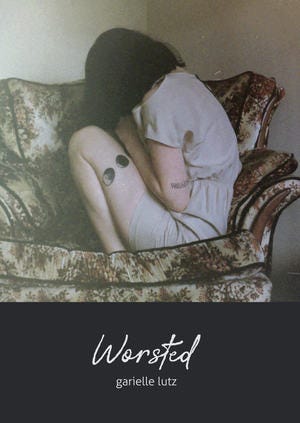
In 2021, Short Flight/Long Drive published Garielle Lutz’s Worsted, a collection of short stories, the first of which shares a title with the collection. That titular story Worsted—which from now on Worsted will refer to—is too a collection of shorts, scraps of fragments of lumps of the narrator’s life.
Reading Worsted is, in the best way, like breathing fumes. Each fragment is fraught with a certain malignant misalignment, a displacement between what was and what should have been, physically, or mentally, or temporally. Lutz’s prose worms its way through the blood and the brain, and slowly the reader sees a silhouette assume a shape: a life filled with irony and sadness and humor and resignation all at once, a life—in the technical sense of both the following words—successfully lived.
The narrator’s first anecdote, in which they recall a marriage they attended, is our introduction to Worsted’s pinprick wit. To a priest’s confidence in the couple’s marriage—“the couple this, the couple that”—the narrator quips, count again. After all, to the narrator, marriage isn’t for two. One might be forgiven for imagining their wives as a rotating cast of some sort, merry-go-round-esque, up and down, there and gone: “I’d often been married, granted,” they tell us later, then flippantly remind us of such again and again. One wife put it plainly, or then my brother-in-law, one of them, or my wife, one of them anyway, or even a wife was in rehab.
In talking about their wives they exhibit little explicit attraction or affection. Attraction is as a rule restricted to lovers and almost-lovers, flings and fantasies; affection, for Doroth, Worsted’s only named recurring character. The narrator discusses their marriages—till death do us part-marriage, you may kiss the bride-marriage—with the language reserved for outfits and spreadsheets: they exchange pornography with one of their wives, whose offering is deemed presentable and deliverable. Another wife is described as “good about keeping marital hours” and “working at sexual odd jobs.” Speaking of yet another wife, the narrator gives us a glimpse of emotion—a trusting soul and later a traitor—but rapidly beats a retreat to ironic detachment: “We live on different parts of the street now.”
In this way Worsted stretches the distance between idealization and realization. English gives us words like apotheosize, ennoble, exalt, and deify, verbs that elevate their targets to a reverential divinity, but Lutz doesn’t execute their antonyms. She instead banalizes, mundanifies, flattens everything into objects faint and bloodless and indifferently off-center. The narrator, upon mentioning their “only friend” from high school, immediately qualifies their statement: “We were never really all that friendly.” On a set of coworkers: “I never did get it straight who was who from one day to the next.” On the change they received in stores: the cashiers “would hand me bills that were mostly torn.” While recounting interactions with an upstairs neighbor: “I would overexert myself in approximations of exercise, mock aerobics.” Even divorce cannot escape this treatment: their sister is said to be misdivorced.
Nothing embodies this distance better than the humans of Worsted, who then find themselves thus disembodied, distanced from some dimension of themselves.
To hear [the narrator’s friend] tell it, his oldest is rarely present for what her life entails, by which he means only that she is never quite actually in person and instead operates on a kind of delay, trailing after herself in her own wake, sinking only with reluctance into her accumulated life, then backing out again.
My wife, one of them anyway: her body in those stone-gray, encompassing dresses had no real way of explaining itself. She seemed to move at some remove from her footfalls.
The physicality of the writing is quite striking, so much so that I find it hard not to visualize these passages. To me, the narrator’s friend’s daughter appears puppet-like, her body’s movements choreographed, her spirit—or shadow—drifting dimly, dispassionately behind, the two sharing space for but brief moments. The text suggests a lack of human spirit and agency: operates is mechanical, algorithmic, unensouled; regarding trailing and sinking, double-meanings abound, where the former word not only frames the daughter as a follower but also suggests a sort of gradual disappearance (trailing off), and the latter, beyond its passivity, invokes a slow, strangled death. Move at some remove is almost-but-not-quite too clever; remove echoes move in the same temporally separate way that, in my audiation, the narrator’s wife’s footfalls echo her footsteps.
And my mother? There was a biographical side to her life, no doubt, though nobody had ever thought to take notes. You were left to assume that certain qualities, tics, and anything plausibly endearable about her would later be attributed to somebody hardly her better.
Lutz at her best: devastatingly funny and devastating, a paragraph that reaches out and snatches you right back when you intimate that you might want to move on. That a life might have a biographical side for which nobody had ever thought to take notes suggests a deluge of implications—that there could be a non-biographical side of life (but aren’t all of life’s aspects biographical?); that under that objection there could be a non-biographical side of her life; that thus her life must have been in some way unstoried and destitute; that in the end even those storied sides would be utterly muddled up with the unceasing drudgery of our sludgy yesterdays.
Worsted was Lutz’s first published work under the name Garielle, and with its release she came out as a transgender woman. Gender is, of course, another axis by which Lutz explores distance and disembodiment. The narrator’s gender is not specified, though it would be reasonable to read them as a transgender woman, or at least as gender non-conforming.
My life reeks of other people, least of all me. As a boy, I’d been daughterish, dawdling—hardly the type to stay put in the lineage.
I had to go in for my annual eye exam and afterward made a point of picking out frames from the women’s section. “Good!” said the clerk, a woman by nature.
The latter passage is one of the only passages—made a point of—in which the narrator sheds their apparent passivity. (I could find just one other: “I needed to take some decisive, laggard action,” they say, before visiting a museum.) We’re given plenty of little snippets of life, but they mostly have a dingy, detached, directionless happeningness to them. For two days, I watched cable TV behind drawn drapes, walked to fast-food places, bought newspapers just for the obits, the police blotters, the bingo updates. Facts appear one after another. He looked rough and ruined. He chewed his food half-mouthedly. One gets the sense that the narrator has wants, wants vague and unsatisfiable, but that they cannot or will not articulate them. I’d unscroll the sheets, but they wouldn’t stay flat no matter what.
Then “made a point of picking frames from the women’s section,” of the narrator’s doings, may be the most explicitly purposeful one. One might call it—that craving to escape the confines of the body—the original desire, the ur-desire by which the narrator comes to comprehend this displacement from the self, others’ and their own. As such, mirrors reveal themselves to be the narrator’s nemesis. A mirror is just about the last place I’d ever want to be seen, they say. Then, later, I once paid full price for a mirror […] The idea was to stand up to myself, or at least stand watch. They leave it unopened in its box. What better than a mirror to throw this displacement in one’s face? What better than that which purports to show the self, but can reflect only one flimsily simple dimension of such?
So reading Worsted is, in the best way, like breathing fumes. The reader absorbs Lutz’s dreary disposition through the drabby miasma of her sentences. She doesn’t strip things of their color; rather, she draws out latent browns and grays, the world’s unseen muck and gunk, dried blood and rust and burnt cigarette butts, saying this is how everything looks through my eyes, and now yours too.
This can’t be humanhood as intended or as usually understood, the narrator remarks to themself, in a seemingly throwaway paragraph midway through the short story. Something is not right. Perhaps it never will be.
To learn more about Garielle Lutz’s writing, you can read The Sentence is a Lonely Place, or read her short stories yourself.